Imagine taking the blueprint of an experience and laying it on top of another experience. The two experiences will fuse into each other. Two realities will collide. We go through colliding moments all the time, sometimes we barely notice while other times it’s so loud you can’t ignore it.
Imagine the experience is from the past when you were a child, had the emotions of a child and thought like a child and you put that experience over the current one. You can think about Donal Trump and his tantrums. Messy, right?
If you know that past experiences can overlap current experiences, you have an advantage. You are in a much better position to feel good and empowered about life. Most confusing situations, and almost all patterns (!), can be clarified if you look at how the past is bleeding into the present and then you can make an empowered choice that is in integrity for who you are (and want to be).
Pattern: “I’m always trying, I’m exhausted”.
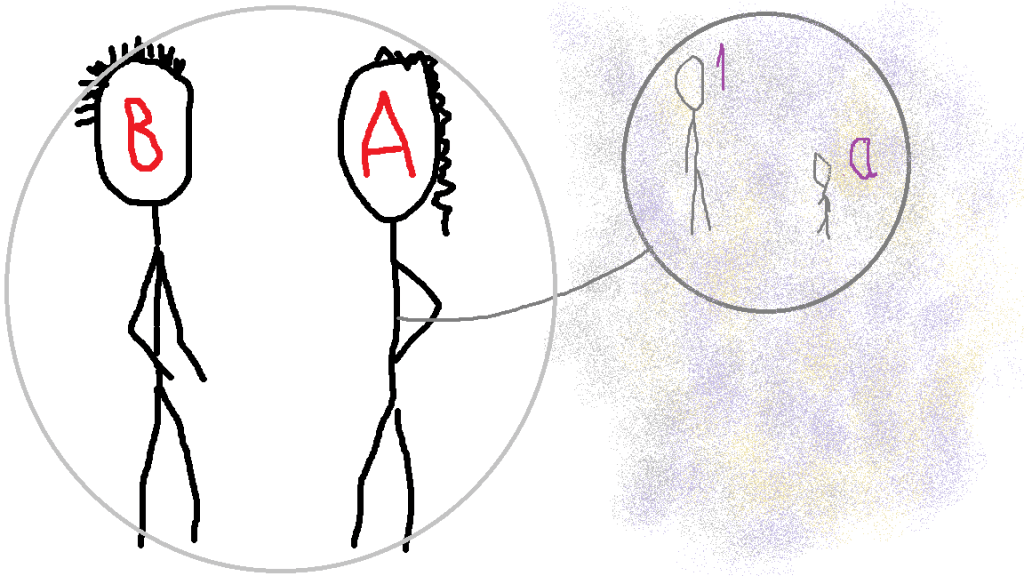
In my excellent stick figure drawing you can see two realities. On the left side in the white area, you have person A and person B in the current “here and now”-reality. Person A and person B are a couple.
On the right side, next to A, you see a shaded area. That’s A’s internal reality. The bubble represents a past experience. The big stick figure is A’s mom (1) and the small stick figure (a) is A when she was a child.
Sometimes we go through something once and it sticks with us for the rest of our lives. In this example, the experience didn’t happen once; it was a regular occurrence. The way the experiences is dealt with matters a lot for how it affects us later in life.
Some people believe the past don’t affect them, especially if the experience was mundane. They believe “negative” long-term effects come from extraordinary and/or traumatic events. To be honest, if you had asked me 10 years ago, I would have said the same. Somewhat shaped by and/or affected by my past – fine, but reenacting my childhood – nope.
I think we don’t acknowledge the extent of which our past is acting out through us. If you think about it, you can find adults acting like children both on a macro and micro level (politicians act like toddlers and parents act like toddlers).
The shaded bubble carries a specific experience from the past. When A was a child, she needed connection to her mom. For a variety of different reasons, A’s mom was not attuned and A was thrust into a pattern of “trying”.
Now that A is an adult, it feels familiar when she is trying to be seen.
A has learned to associate “trying” with love. In a way it feels like “home” when she is trying. Not only is she dealing with a sense of familiarity, the hope of finally being seen is part of it too. As a child, A hoped her efforts would lead to being seen by her mom. Now that she is an adult the desire will be put onto other people in an attempt to “close” the situation. It’s likely that A covertly reenacts the pattern across relationships, but certain relationships or situations can also activate the pattern at full force. The little girl (a) will see mom (1) in other people an attempt to get the experience she always wanted by making herself be seen.
There are endless ways to explain why A got into a relationship with B – a man who resembles her mom. Some will say it’s chance, spiritual people will say they are a vibrational match or have a soul contract, a therapist might say she is subconsciously trying to “close” her past… I believe the past versions of us wants to be seen and somehow life is orchestrated in such a way that what was once forgotten can now be known. A’s relationship with B has similarity to the past and A experiences an intensified pattern activation. Past and present merges. A’s mom (1) suddenly overlaps partner (B), and A is overlapped by her child self (a).
If you’re interested in your own truth or have an affinity for empowering yourself, here are some questions you might want to explore:
Given what you know about your upbringing, pretend you’re a psychologist tasked to write a report that explains how your child-self developed the “pattern of trying”.
Do your best to truly and deeply understand the child you once were. Imagine she is sitting in the chair in front of you. Ask her how she felt when she wasn’t seen, what she did to be seen, what did she make it mean when she wasn’t seen, and how it affected the relationship she had her mom. Observe yourself as you are listening to what she is sharing. There is important information in how you react.
Reflect on what the young child you once were shared in the previous question. How did her experience affect how you feel about relationships as an adult? Does it affect how you show up in relationship? If yes – how?
Think about the young version of you… How do you wish she had been met? Does she have an idea about how SHE wanted to be met? Write it down and don’t hold back on the details.
Imagine the young child you once were… Again, imagine she was sitting in a chair in front of you. What do you want to say to her? Be truthful.
Given what you now know, is there anything you would like to change about the way you show up towards yourself? Is there anything you want to differently towards your partner? If yes, what?
 Gunhild Archer, MD in Psychology and Counseling